
How to Solve the "Data Vacuum" in Headless E-commerce: A Live Next.js 16 & MedusaJS-Ready Demo
Headless storefronts look dead during staging because developers have no realistic imagery or structured seed data. Learn how SceneSKU's Ready-made Scene Packs eliminate this 'Data Vacuum' with a live Next.js 16 demo and open-source boilerplate.
There is a moment every headless e-commerce developer knows. You have spent two days configuring a pristine Next.js 16 App Router project. Tailwind is dialed in. Your product grid is pixel-perfect. The font stack is immaculate. You push to staging, paste the URL into Slack, and wait for the client’s reaction.
The reaction is silence. Not impressed silence. Confused silence.
Because your storefront looks like this:
- Product 1 — $99.99
- Product 2 — $99.99
- Product 3 — $99.99
Three identical grey placeholder squares staring back at everyone on the call.
The Curse of “Product 1” and the Headless “Data Vacuum”
This is not a styling problem or a component problem. It is a data problem — and it has a name.
Call it the Data Vacuum: the friction point in modern headless e-commerce development where a beautifully engineered frontend exists in a content void. You have built the pipes, but nothing flows through them. The stack is live, but the store is dead.
The Data Vacuum kills presentations. It wastes billable hours that should go toward shipping, not sourcing. It poisons UX testing before it starts — you cannot meaningfully benchmark next/image performance, measure Core Web Vitals, or validate your responsive grid when your “products” are all the same grey box at the same aspect ratio.
The typical workaround looks something like this:
{
  "id": "1",
  "title": "Test Item A",
  "price": "$49.99",
  "image": "https://via.placeholder.com/400"
}
Then a second file. Then a third. Then someone downloads five random Unsplash photos, renames them product-1.jpg through product-5.jpg, and drops them into /public. The images do not match. The copy is invented on the spot. The demo feels like a wireframe that accidentally got deployed.
This is not a rare edge case. It is the default state of every headless storefront during its first two weeks of development. And it costs teams real time and real money.
The Solution: A Live Headless Storefront That Actually Looks Ready
The answer to the Data Vacuum is not better placeholder images. It is realistic, structured, production-quality content available before your product catalog exists.
That is exactly what the SceneSKU Next.js Store Demo demonstrates.
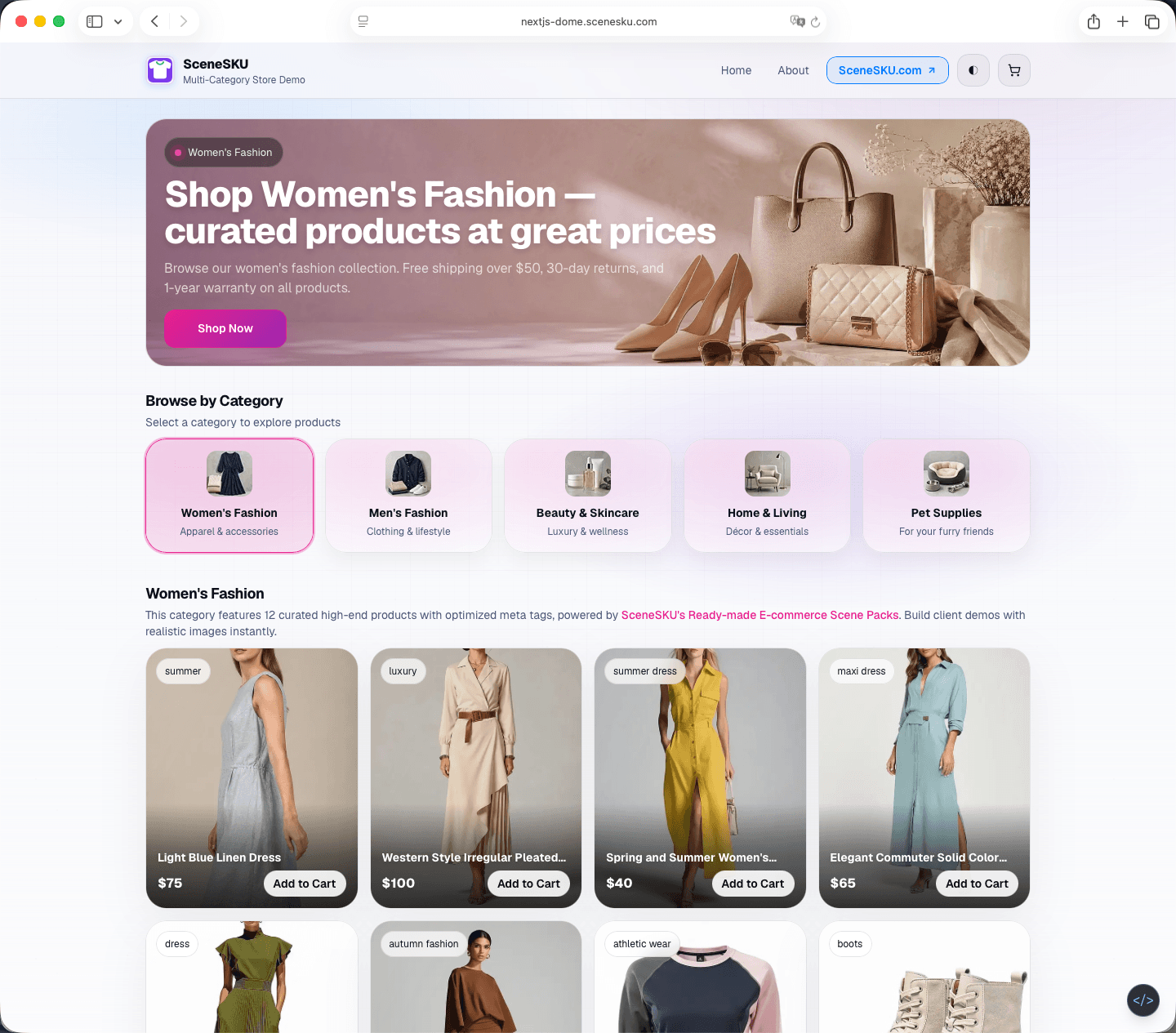
This is not a mockup. It is a live, deployed storefront built on Next.js 16 App Router — and it looked exactly this polished from day one of development, because it was never populated with dummy data.
Instead of locally crafted JSON strings, the demo consumes SceneSKU Ready-made Scene Packs via a lightweight API call. Each Scene Pack is an engineered content bundle: a coherent set of lifestyle product images matched with fully structured e-commerce metadata — titles, descriptions, variants, pricing, SEO fields, slugs, and feature bullets — all built to work inside a real product grid.
The visual and data harmony is intentional. The images are AI-curated for specific product categories (fashion, beauty, home goods), so they read as a real brand collection rather than a pile of stock photos. The structured data that accompanies them is not Lorem Ipsum — it is production-shaped copy that slots directly into your component props without any massaging.
The depth extends beyond the product grid. Each item ships with a full multi-image gallery, structured feature bullets, semantic tags, and related product associations — everything a production detail page needs, out of the box.
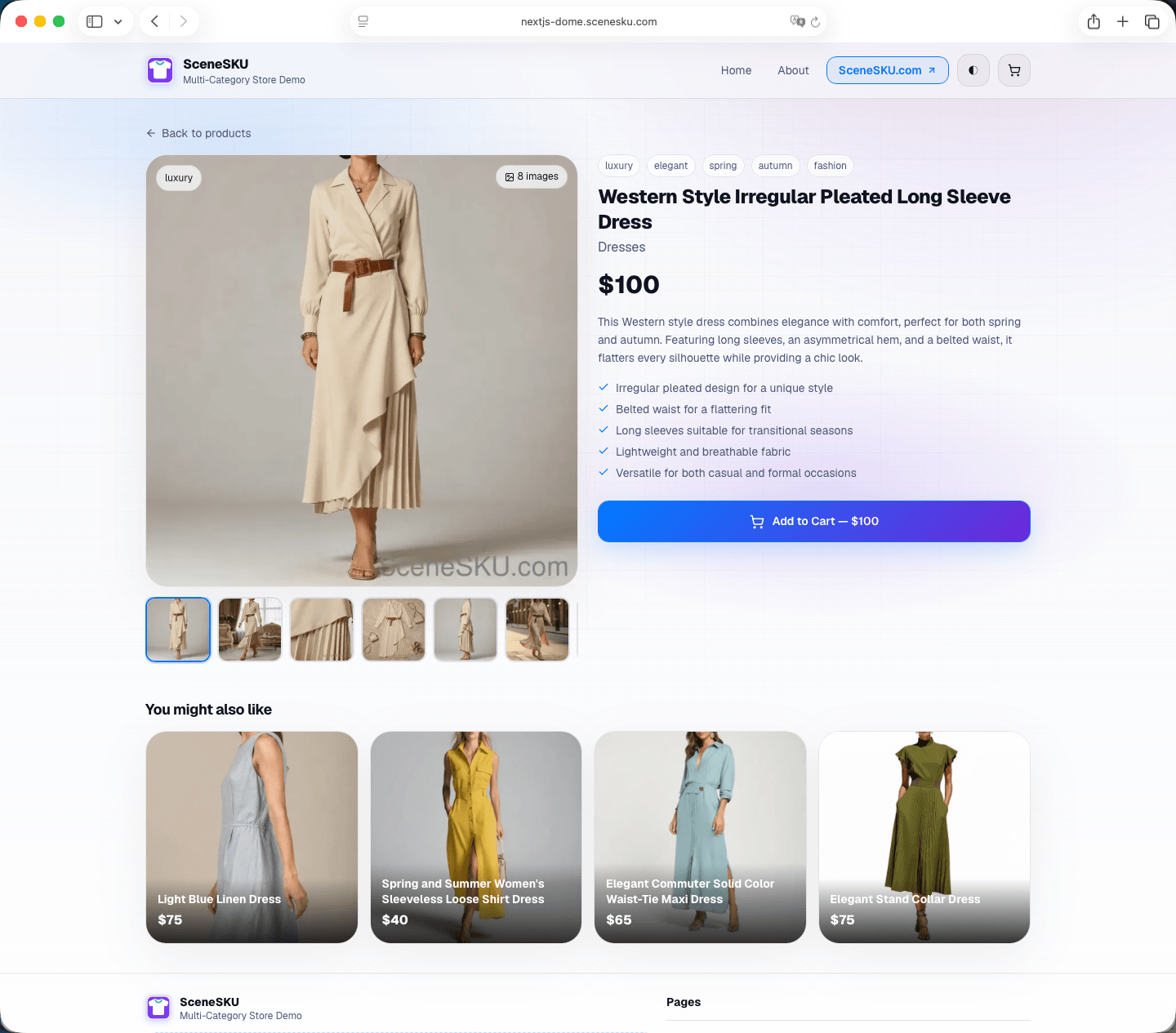
The result: a headless storefront that looks like it is two weeks away from launch on the first day it is deployed.
What You Get, Instantly
The integration is a single API call. No data modelling, no content fabrication, no Unsplash hunting. What comes back is a complete, production-shaped content bundle ready to drop into your component tree.
Each Scene Pack delivers:
- Multi-image galleries — 6–10 lifestyle shots per product, consistent lighting and composition throughout the category
- Fully written copy — product titles, short descriptions, long descriptions, and feature bullets that read like real product pages, not placeholder text
- SEO fields included — meta titles, meta descriptions, and URL slugs shipped with every product record, not bolted on later
- Structured variants and pricing — size options, color options, and suggested price points that mirror real catalog structures
- Semantic tags and categories — organized taxonomies that plug directly into your filter and navigation logic
Fits Your Stack Without Rewiring Anything
SceneSKU data is designed to map cleanly to the schemas you are already using:
- Next.js Server Components — fetch a pack at the route level and pass typed product objects straight into your existing card components
- MedusaJS — the product schema aligns directly with MedusaJS product fields, so a single seed script takes a local backend from empty to a populated catalog in under a minute
- Any headless API — titles, descriptions, slugs, images, and variants follow standard e-commerce data shapes, so the response slots into Shopify, Commerce.js, or a custom backend without transformation
No boilerplate to write from scratch either. The scenesku-nextjs-store-demo on GitHub is a complete, production-ready Next.js 16 storefront with routing, product detail pages, image optimization, and the SceneSKU API wired up. Clone it and your next project starts populated, not empty.
Why AI Search Engines and Crawlers Love This Approach
Filling a headless storefront with structured scene pack data is not only a developer experience improvement. It has measurable downstream effects on SEO and Answer Engine Optimization (AEO) from the moment a site is indexed.
Visual Alignment Accelerates Client Sign-Off
AI-curated scene sets enforce strict aesthetic consistency across a product category. Every image in a Women’s Fashion Scene Pack maintains the same lighting style, backdrop tone, and composition language. When a client reviews a staging environment that looks this cohesive, the feedback loop compresses dramatically. There is no “can you make it look less stock-photo-ish” note because the imagery was engineered specifically for e-commerce contexts — not licensed from a generic repository.
Structural Integrity Produces Schema-Ready Metadata from Day One
SceneSKU product data is not Lorem Ipsum with a price attached. Each product record ships with:
- SEO-optimized titles and meta descriptions
- Clean, human-readable URL slugs
-
Structured feature bullets (compatible with
ItemListschema markup) - Category taxonomies and semantic tags
- Variant and option structures that match real-world product catalogs
This means the structured data you expose to Googlebot, Perplexity, and ChatGPT Search on launch day is meaningful content — not development noise. Sites that launch with well-formed product schema from the start tend to index faster and surface more accurately in AI-powered search results.
Performance Testing Becomes Meaningful
next/image optimization, Largest Contentful Paint (LCP) measurements, and Core Web Vitals scores are only meaningful when tested against realistic content. A product grid of identically-sized grey boxes will produce misleading performance benchmarks. Scene pack images are real photographs at real aspect ratios — which means your performance profiling during development reflects what your production environment will actually experience.
Stop Wasting Engineering Hours on Dummy Data
The Data Vacuum is a solvable problem. It has been accepted as a normal tax on headless development for too long — the assumption that every new storefront project must begin with a round of manual content fabrication before any real work can happen.
It does not have to work that way.
The live SceneSKU Next.js Store Demo is proof that a headless storefront can look production-ready on day one. The open-source repository gives you the architecture to replicate that immediately on your next project.
Here is what to do next:
-
Clone the repo —
git clone https://github.com/scenesku/scenesku-nextjs-store-demo— and use it as your headless boilerplate - Browse the live demo at nextjs-demo.scenesku.com to see what a properly populated storefront looks like in staging
- Sign up at SceneSKU to get your free API keys and browse the available Scene Pack catalog for your product category
The next headless project you demo to a client should not have a single grey box in it.